|
|
|
|
|
Hi there and thank you for reading the Arrest That Shook Froid. In this edition, you’ll find an update on Roberto Orozco-Ramirez’s location, details on a new civil case his lawyers have filed, a look inside the Cascade County Detention Center where he was incarcerated for more than two months and much more. Please share your feedback with our team at border@montanafreepress.org.
|
|
Where is Roberto Orozco-Ramirez?
|
 |
|
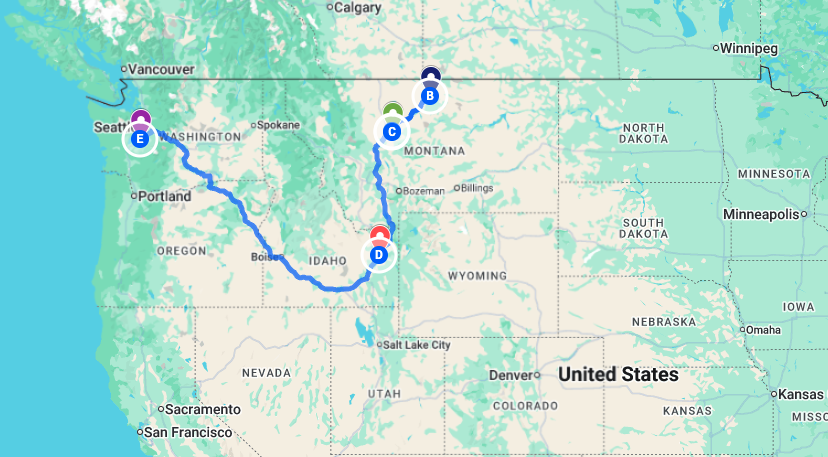
A screenshot of Google Maps, where I mapped out what we know of Roberto Orozco-Ramirez’s path since he’s been in ICE custody.
|
|
Last week, Roberto Orozco-Ramirez was transferred from the Cascade County Detention Center to Border Patrol custody and then U.S. Immigration and Customs Enforcement (ICE) custody.
When I wrote this newsletter last week, his family and his lawyers didn’t know his whereabouts. Even though his criminal charge was dropped, new court documents show that the U.S. Department of Homeland Security had put a “detainer” on Orozco-Ramirez, essentially asking the Cascade County jail to hold him until federal immigration officials could pick him up.
Now, we have new information on where he’s been. Here’s what court documents and online databases show.
On April 16, federal immigration officials took Orozco-Ramirez from the Cascade County Detention Center to the Havre Sector Border Patrol office, about 118 miles east of Great Falls. There, according to court filings, Border Patrol officers asked him to sign unspecified documents. Culbertson-based attorney Laura Christoffersen, one of Orozco-Ramirez’s attorneys, wrote in court records describing the incident that she advised him not to sign paperwork “without my being able to review them first.” Court records allege that the Border Patrol agent overseeing the situation said he could not email Christoffersen the documents and that the agency would not provide information to help identify what the documents were.
(In his criminal case, Orozco-Ramirez’s public defenders argued that when Orozco-Ramirez was first deported from the U.S. in 2009, he unknowingly signed a document allowing for his removal from the country and waiving his right to a hearing. Immigration lawyers have told me that undocumented immigrants may be pressured by officers to sign such removal orders without understanding the consequences.)
By 10 a.m the next morning, on April 17, Orozco-Ramirez was back at Cascade County Detention Center.
On April 20, ICE’s Online Detainee Locator System showed Orozco-Ramirez getting farther away from home — the federal database recorded him at Jefferson County Jail in southeast Idaho.
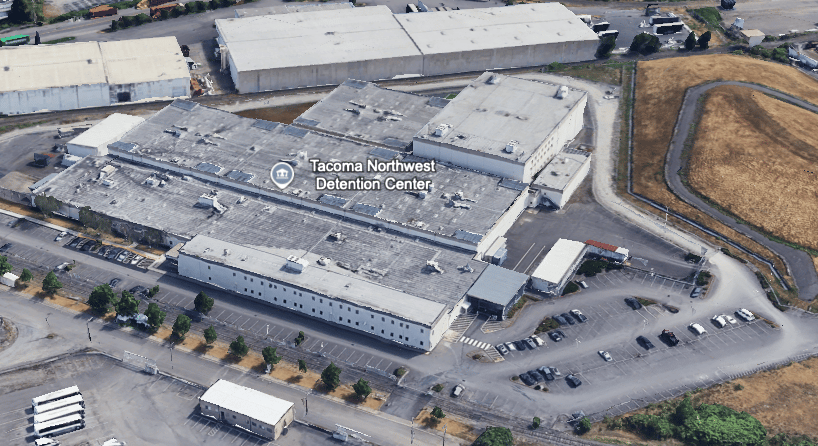
And as of April 23, the locator system listed Orozco-Ramirez at an ICE detention facility in Tacoma, Washington — 1,037 miles away from Froid.
|
 |
|
A Google Earth view of the ICE detention facility in Tacoma, WA where Roberto Orozco-Ramirez was held as recently as April 22.
|
|
Each time I saw Orozco-Ramirez’s name pop up in a different location, I entered that place into a breadcrumb trail of the Froid resident’s path. Since he left the Cascade County Detention Center, Orozco-Ramirez has traveled at least 1,360 miles in federal custody.
When I asked Kari Hong, a Missoula-based immigration attorney, why Orozco-Ramirez may have been transferred so many times, she said she wasn’t sure.
“There are a lot more transfers of Mr. Orozco than what my other clients endure,” she wrote to me in an email Thursday. “All of this detention is civil, meaning that there is no legal reason why ICE has to detain him at all. They are free to release him, they are free to not detain him, they are free to have him voluntarily report to them on a regular basis.”
There have been many news reports on poor conditions at ICE detention facilities nationwide amid President Donald Trump’s mass-deportation campaign. Articles detail overcrowding, lack of access to health care, alleged abuse and other harsh conditions. Since Trump took office in 2025, 46 people have died in ICE custody, according to the federal government. An October 2025 story from KING 5, a Seattle-based broadcast station, detailed what immigration advocates called dangerous and inhumane conditions at the ICE facility in Tacoma, where Orozco-Ramirez was as of Thursday.
|
|
|
|
|
|
|
A new court case
|
|
Let’s rewind a week. On April 14, a federal judge dismissed the felony criminal charge against Orozco-Ramirez. A few days later, Orozco-Ramirez’s lawyers filed a civil lawsuit against various law enforcement and government officials on his behalf.
In the new civil case, Orozco-Ramirez’s lawyers argued for his release from custody, saying he is “neither a danger to the community nor a flight risk.” They say his continued detention violates his right to due process.
“Each day Mr. Orozco is unjustly deprived of his liberty causes irreparable harm,” his attorneys argued in court documents. “This is particularly true given that Mr. Orozco is the primary breadwinner for his family.”
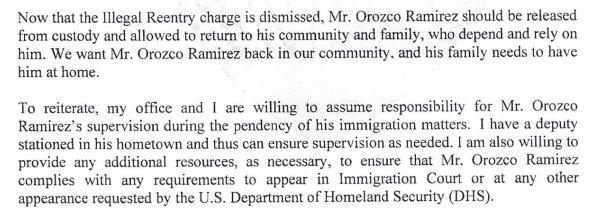
Included in the lawsuit is a letter from Roosevelt County Sheriff Jason Frederick, whose law enforcement jurisdiction includes Froid. Here’s a snippet of what he wrote:
|
 |
|
A screenshot of a letter from Roosevelt County Sheriff Jason Frederick advocating for Roberto Orozco-Ramirez’s release. The letter was included in court documents.
|
|
If Orozco-Ramirez cannot immediately be released from custody under the supervision of Sheriff Frederick, his lawyers alternatively requested that he have a bond hearing, where a judge can assess whether detention is warranted. The lawyers also argued the matter should be determined in the United States District Court for the District of Montana and not in immigration court. They argue that, under the Trump administration, immigration judges are “anything but impartial.” A recent NPR report found that the Board of Immigration Appeals, an administrative panel that interprets immigration laws, has been reshaped by the Trump administration and has been overwhelmingly siding with the federal government on the cases it reviews.
I reached out to the government agencies and officials named in Orozco-Ramirez’s civil lawsuit — including representatives from the Cascade County Detention Center, ICE Enforcement and Removal Operations Salt Lake City, ICE, Department of Homeland Security, U.S. Customs and Border Protection and Acting Attorney General of the United States Todd Blanche. They did not respond to my requests for comment before publication. Generally, defendants have 21 days to respond to a complaint once they are served, though government officials typically have an even longer window.
|
|
|
|
|
|
Inside Cascade County Detention Center
|
 |
|
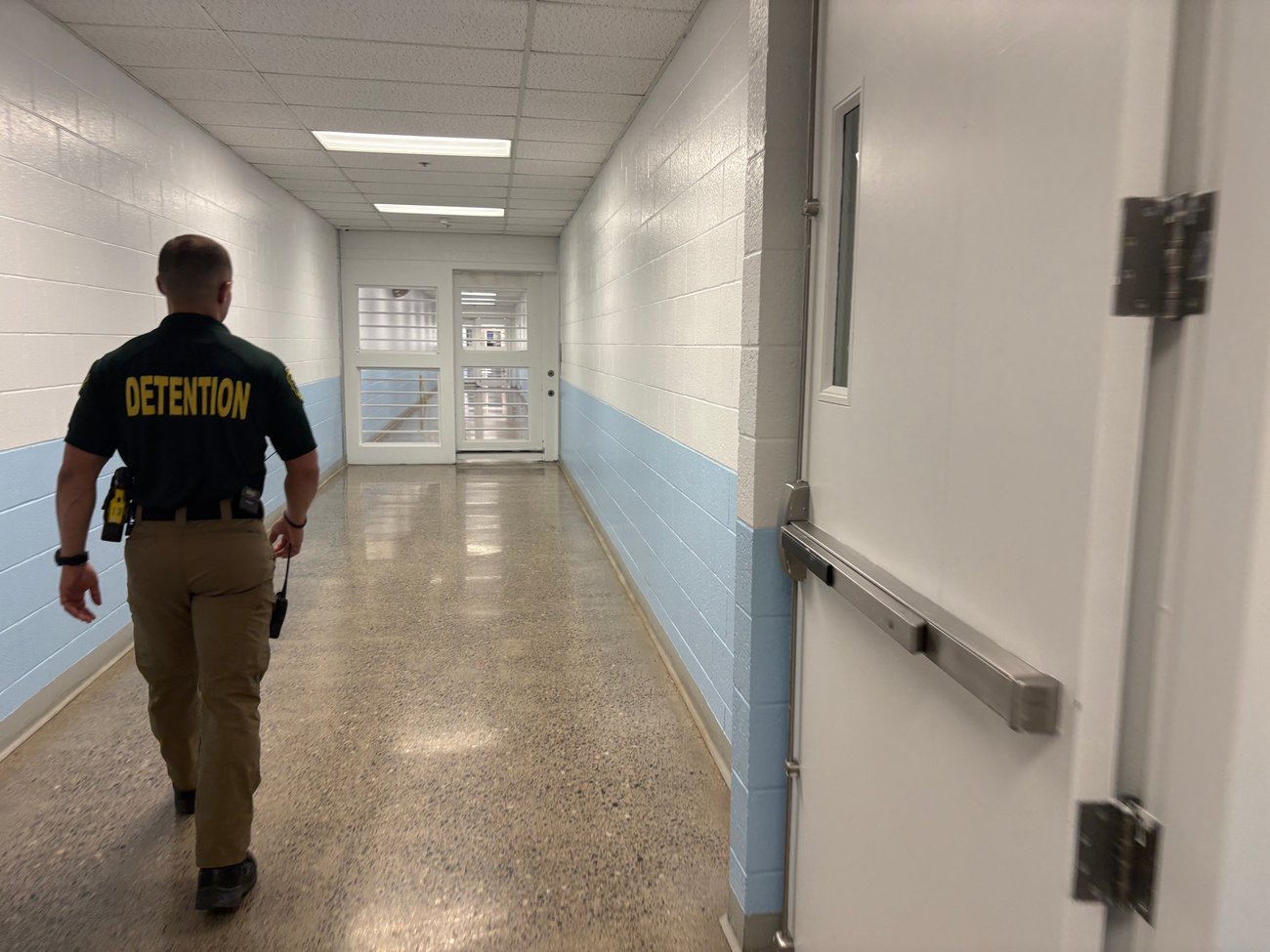
Lt. Robert Ruiz toured me around the Cascade County Detention Center in Great Falls on April 22, 2026. Credit: Nora Mabie / MTFP
|
|
Yesterday, I toured the Cascade County Detention Center in Great Falls, where Orozco-Ramirez was incarcerated for more than two months. The facility has a capacity of 372 inmates, and officials told me that they typically house between one and 15 people facing federal immigration charges each day.
In October, the Cascade County Board of Commissioners approved a contract with U.S. Customs and Border Protection, ensuring the county is compensated for detaining federal inmates. The federal government, according to the contract, pays Cascade County $115 per immigration inmate, per day.
|
 |
|
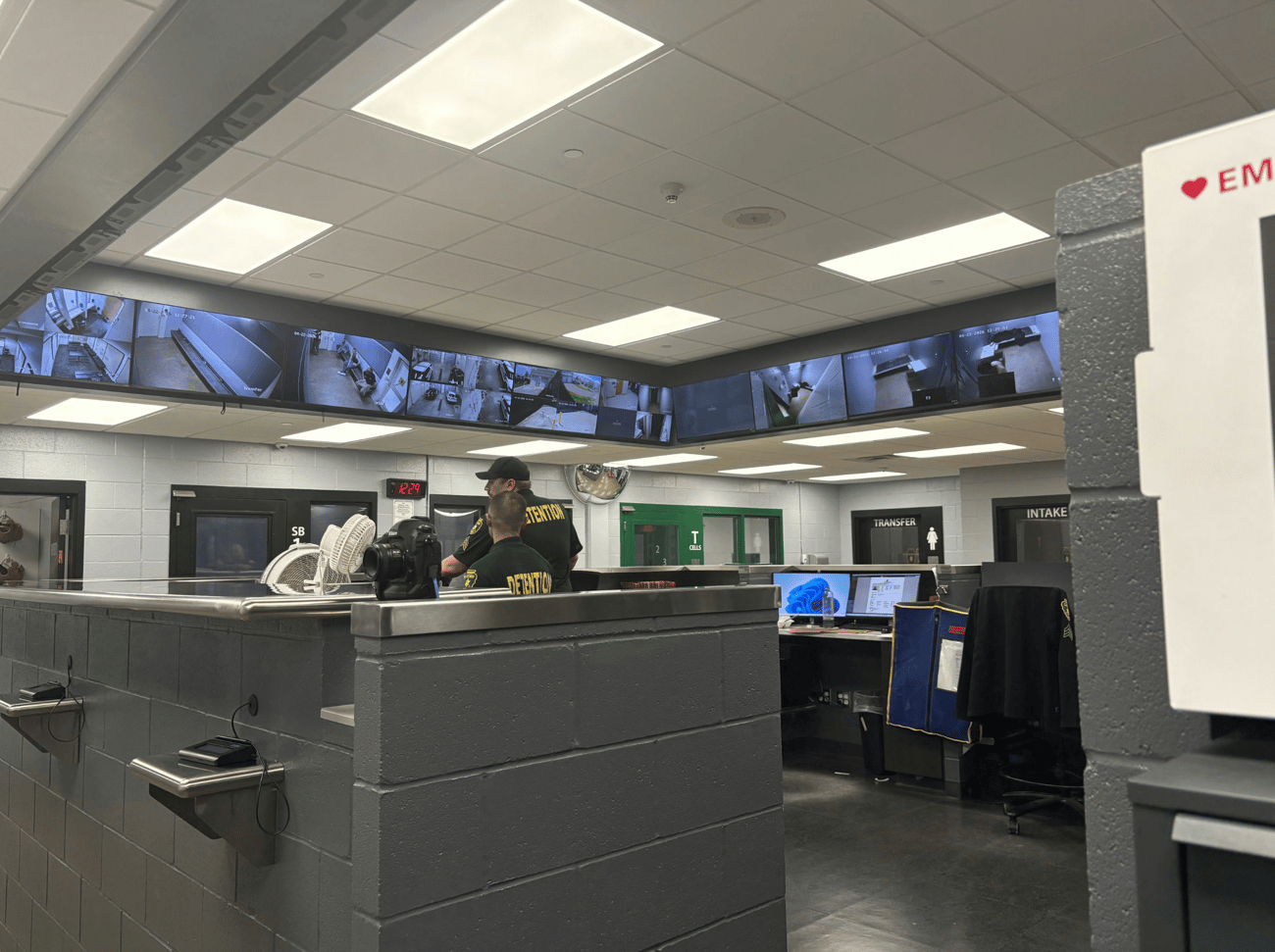
The booking area of the Cascade County Detention Center. Called “grand station” by detention officers, this is where inmates are admitted or released. Officials told me this is likely where Roberto Orozco-Ramirez was transferred to ICE custody. Credit: Nora Mabie / MTFP
|
|
When I visited the facility, the hallways and rooms of the detention center were hot. It was about 65 degrees in Great Falls that day and the air conditioning was not yet turned on in the detention center, so big box fans were buzzing in most rooms. The cinderblock hallways are painted light blue and white. There are security cameras in every room and detention officers escort inmates between their cells and communal spaces, like the recreation area and medical offices. Inmates also have access to digital tablets where they can connect with family members via video call.
The Cascade County Detention Center officials I spoke to during my tour said they didn’t know much about what happens when inmates are transferred out of their facility and into ICE custody. To their knowledge, they said that detainees, like Orozco-Ramirez, are also not told where they are being taken when ICE picks them up.
The detention center holds people accused of committing all types of crime, from rape and murder to a DUI or, in Orozco-Ramirez’s case, illegal re-entry. When that charge was dropped, the facility agreed to continue to hold him until ICE took custody.
Cascade County Detention Center officials described their jobs as “not glamorous” and said the facility would need to hire about 37 more detention officers to be adequately staffed. They said many of the inmates need mental health services. As I walked into the booking room, one inmate sitting on a bench called the detention center “a terrible place.”
|
|
|
|
|
|
Reader dispatches
|
|
I’ve been exchanging emails with a reader named Denise Feller since we launched this newsletter. She’s shared many questions about Orozco-Ramirez’s history in the U.S., as well as her general thoughts about immigration enforcement. With her permission, here’s what she wrote to me last week (Feller’s email has been lightly edited for clarity):
“I still want to know if he voted, got a driver’s license, got a loan, etc. If he did, he had to have an ID, so where did he get this? Also, I would like to know if any law enforcement officer ever asked for his citizenship papers. If not, why not? This is a man who clearly broke our laws and deserves punishment. If none is given, then disband all our laws.”
I’ve been speaking with immigration experts to answer Feller’s questions. Here’s what I’ve learned so far.
In some states, but not Montana, immigrants can legally obtain a driver’s license. Local law enforcement entities are generally not required to ask for someone’s immigration documents if they encounter them during routine traffic stops or other similar incidents. Experts also told me that undocumented immigrants often pay property and income taxes. (Sidenote: I’m working on a story now about how local law enforcement interact with federal immigration enforcement entities, so I’ll have more information to share on this topic soon).
Gregory Cameron, another reader from San Francisco, asked:
“How many Montana residents are in favor of this type of immigration enforcement? I mean, it's easy to surmise that his family thinks it sucks. Friends of his who were making 7 hour drives think the system sucks, too. But, what, 80% of the residents in this corner of the state voted for the Republicans and think that Democrats are ruining America. Those are the ones I'm interested in.”
|
 |
|
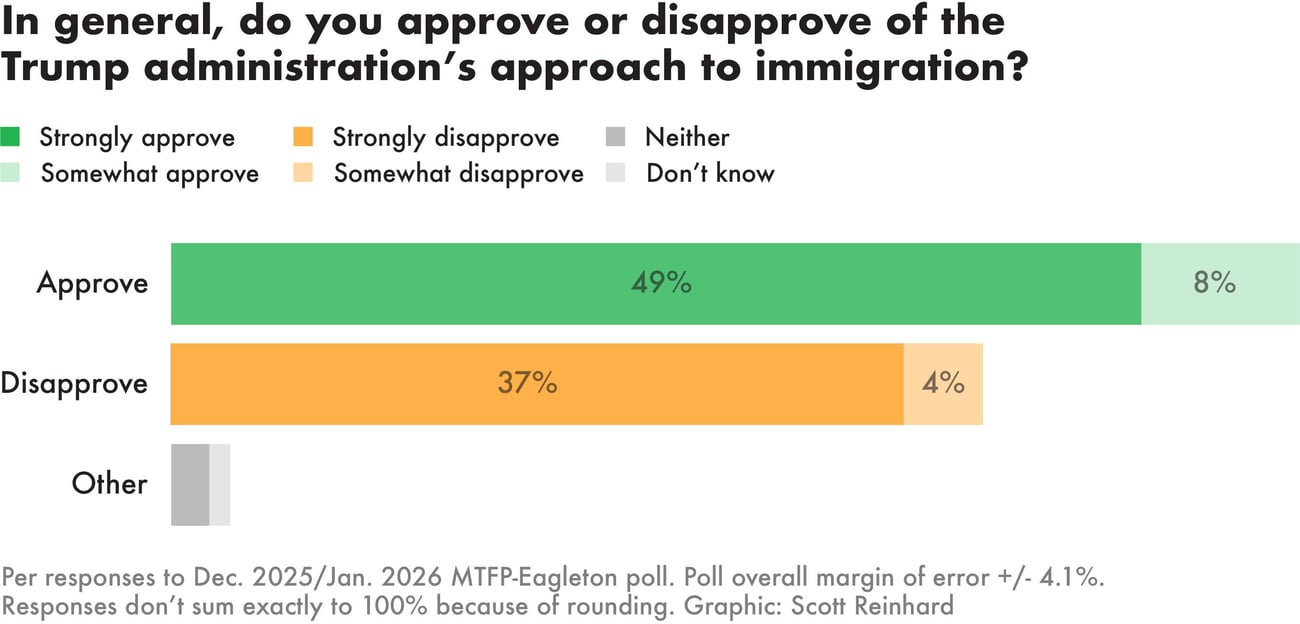
Montana Free Press recently conducted a poll on how Montanans feel about Trump's immigration policy. The results were fairly evenly split between proponents and opponents. But we found that respondents on both sides of the issue, 85%, expressed strong feelings one way or the other. Most Republicans in the state said they "strongly approve" of Trump's immigration enforcement, while most Democrats said they strongly disapprove. You can read more about our poll here.
What other questions do you have for our team? Please send them to border@montanafreepress.org. As always, thanks for reading.
|
|
|
|
|
|
|
|
|