|
|
|
|
|
A faction of out-of-office Montana politicians is trying to sidestep Citizens United, the 2010 U.S. Supreme Court decision that classified corporate political spending as a form of protected speech and enabled businesses to spend unlimited money on political campaigns. This is not the first time Montana has resisted corporate dollars in politics — the U.S. Supreme Court in 2012 rejected the state’s claim that its century-old Corrupt Practices Act exempted it from complying with Citizens United.
Though backers of this iteration’s strategy think they’ve found a magic bullet, legal experts aren’t convinced the outcome this time around will be different.
The Transparent Election Initiative is advocating for a 2026 constitutional initiative that would alter Montana’s corporate charter, the legal contract between a state and a business allowing the private entity to operate within Montana’s borders. The proposal would change new and existing in-state charters to explicitly prevent corporations from donating to any political campaigns. Its proponents also believe existing Montana corporate law would delegate the new restriction to effectively include any corporation moving money around inside the state.
Jim Bopp, the Indiana litigator who represented Citizens United during the early stages of the Supreme Court case, dismissed the initiative's legal foundation during an interview with Montana Free Press on Thursday. Bopp said the effort would relocate the legal battleground from campaign finance law to corporate law, but would not circumvent a corporation’s First Amendment right to spend money on elections.
“It could be criminal law. What difference would that make? They’re all prohibitions on speech,” Bopp said.
He also doubted that the initiative would prevent out-of-state corporations from spending money in Montana’s elections.
“Corporate governance is determined by the state of incorporation,” Bopp said, arguing that Montana would be attempting to impose an unconstitutional mandate on corporations with headquarters outside the state.
Former Democratic Gov. Steve Bullock, though, thinks the strategy just might work. He, former Democratic U.S. Sen. Jon Tester and former Montana Commissioner of Political Practices Jeff Mangan support TEI. Bullock was Montana’s attorney general in 2012, representing the state in the Supreme Court case.
“I don't think there's any way that you take a direct Citizens United challenge — like we did with the Corrupt Practices Act — and the court would do anything other than affirm Citizens United,” Bullock said in a Thursday interview with MTFP. “This is less about Citizens United, in some respect, than it is about what powers corporations have and who actually sets those powers.”
Constance Van Kley, a law professor at the University of Montana who previously worked at Upper Seven Law, declined to predict how the U.S. Supreme Court would rule if the proposed constitutional initiative passed and was subsequently challenged, but offered an interpretation of the existing precedent.
“They have said that you have, essentially, a near-absolute right to try to influence the way that people vote using your dollars,” Van Kley said Thursday, noting also that the initiative’s legal theory doesn’t directly replicate past arguments.
“Is the approach that is being proposed here squarely foreclosed by Citizens United? No, they didn’t decide this particular issue. It was a different law,” Van Kley said.
Before Montanans can vote on the issue in 2026, the initiative must pass a series of administrative and logistical hurdles, including a language review by the Legislative Services Division, an attorney general assessment of the measure’s legal structure and a large-scale signature-gathering campaign that will be reviewed by the secretary of state’s office.
There’s also a possibility that state Attorney General Austin Knudsen could declare the initiative legally insufficient.
“If the AG finds that the initiative is legally insufficient, the proponents must ask the Montana Supreme Court to override that determination before the petition can be prepared for signature-gathering,” Van Kley wrote in an email to MTFP.
|
|
|
|
|
|
|
3 Questions For 
|
|
|
As president of the Federal Reserve Bank of Minneapolis and a rotating member of the Federal Open Market Committee, Neel Kashkari plays a central role in deciding the country’s monetary policy. Kashkari recently visited cities and towns across Montana, the westernmost state in his economic region.
After speaking to a gathering at a Helena hotel Thursday, Kashkari said in an interview that he enjoys traveling his district because “data only tells part of the story, but the anecdotes really help bring the data to life.” At the event hosted by the Montana Chamber Foundation, Kashkari responded to questions from the audience before his conversation with a Montana Free Press reporter. Questions and answers have been condensed and edited for clarity.
MTFP: How can Montanans understand your relationship to them?
Kashkari: I'm representing them. At the Federal Open Market Committee, my job is, in part, to talk about what's happening here in our regional economy. We have to make a decision for what's right for the country as a whole. I'm not voting on interest rates for Montana or for Minnesota. I'm trying to decide what makes sense for the country as a whole. But I want to make sure what's happening on the ground here in Montana is part of that consideration.
MTFP: What major economic factors do you consider as a representative of Montana?
Kashkari: [Agriculture] is obviously a huge factor, and tourism. I was in Bozeman yesterday — the tech sector is growing here in a way that it isn't in most of the region that we cover. So I think Montana has some real differences that are strengths, but also different economic environments that could be weaknesses. Nobody's immune, and nobody's gonna have a perfect economy all the time.
Jennifer Isern, Montana Community Foundation: How do you see the economy here in Montana vis-à-vis other states in your region?
Kashkari: The No. 1 challenge that I mention is housing. And people will acknowledge it's kind of a problem of success: A lot of people want to come here. I know there's a love-hate relationship with the show “Yellowstone.” I understand. I've never seen it myself, but I understand it. And so I think Montana has a lot going for it. I think tourism is a bigger part of your economy here than it is in some of the other states that we cover. And that's both a source of strength, but also it has some weakness. It has a risk associated with it: If there's a broader downturn, people don't want to travel; there's an exposure to this. So I think Montana is very well-positioned. I think the advice I would give you — you already know — the only solution to housing is more housing. That's it. There's nothing else. There's no point talking about anything else.
|
|
|
|
|
|
|
|
|
Viewshed 🌄
|
 |
|
Photo Credit: Courtesy Milk River Project |
|
|
|
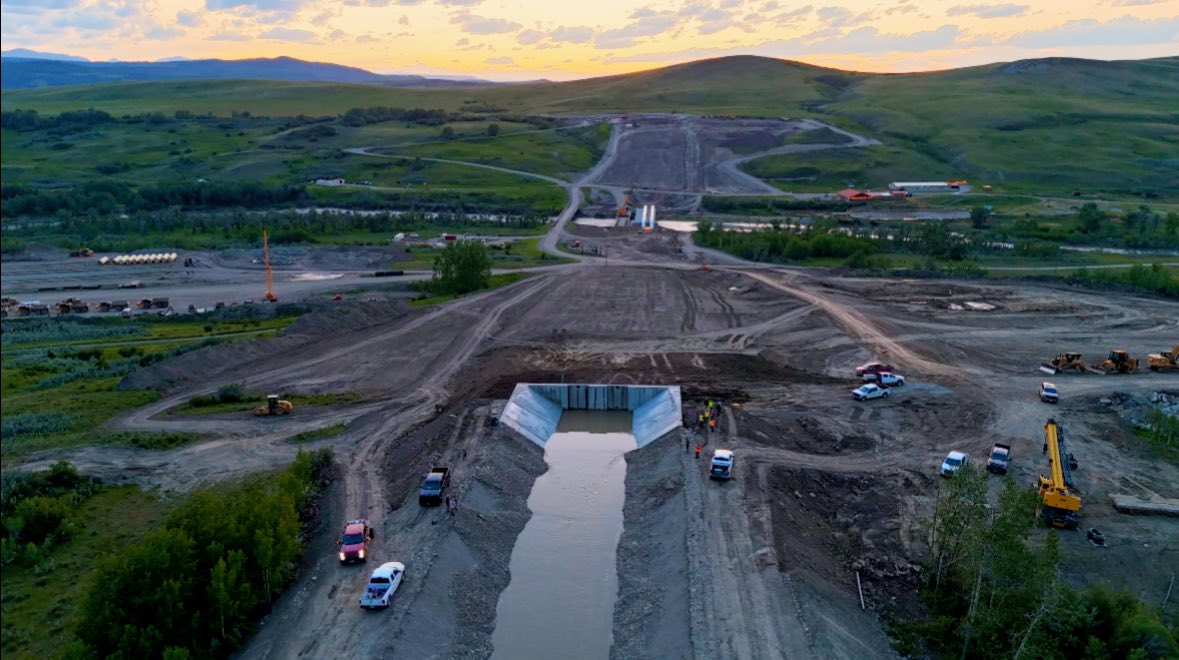
Water is once again flowing through the St. Mary siphon, restoring a critical resource to Hi-Line communities dependent on the Milk River Project for drinking water and irrigation.
The milestone, announced early Thursday morning on the The Milk River Project Facebook page, comes one year and nine days after a catastrophic failure of the St. Mary’s siphon flooded some areas of northwest Montana and left communities to the east without a critical water source. The price tag for the repairs to the massive water transfer and storage project, some of which are ongoing, is estimated at $70 million.
“What a journey it’s been to get to this point from emergency response to full rebuild,” The Milk River Project wrote in a press release about the century-old project, which spans 350 miles. “This project is a testament to the intricate canals, siphons and diversions designed for a seamless flow of water.”
“Getting this siphon back online within a year is a remarkable accomplishment and a reflection of our commitment to the people who rely on this water every day,” Ryan Newman, the Bureau of Reclamation’s Montana Area Office manager, said in a Wednesday press release. “Reclamation, working shoulder to shoulder with the [Milk River] Joint Board [of Control], the Blackfeet Nation, and the State of Montana, ensured this project remained on track under extraordinary circumstances.”
|
|
|
|
|
|
|
Departed 🥀
|
 |
|
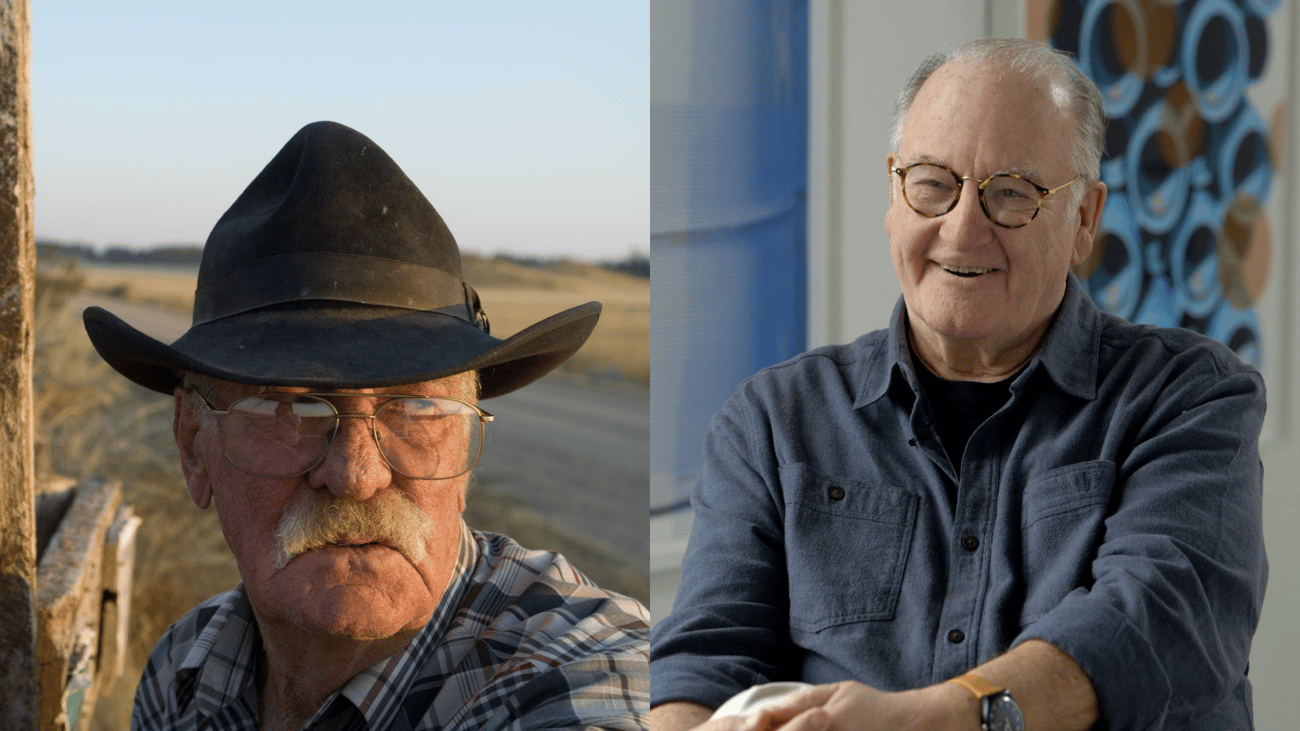
Wally McRae, left, photo by Jessica Brandi Lifland. Pat Williams, right, photo courtesy of the Williams family. |
|
|
|
The state lost two legacy-leaving giants this week in the respective (and rarely conjoined) fields of poetry and politics. Sunday marked the passing, at age 89, of Colstrip-born cowboy poet and ag-life advocate Wally McRae, and Wednesday brought news of the death, at 87, of Butte son Pat Williams, the former Democratic legislator who left office at the end of his 1979-1997 tenure as Montana’s longest-serving representative in the U.S. House. This week, Amanda Eggert rounded up recollections of McRae as a man defined by his talent as a writer, performer and organizer of straight-shooting integrity, while Tom Lutey talked to colleagues who remember Williams, a schoolteacher before he became a politician, for his authenticity and work on behalf of less fortunate Montanans. The two men intersected in public honor as recipients — McRae in 1989, Williams in 2010 — of the Montana Arts Council’s Governor’s Arts Award, recognizing “outstanding Montana citizens and organizations whose achievements in the arts, or on behalf of the arts, benefit all Montanans.” |
|
|
|
|
|
|
By the Numbers 🔢
|
 |
|
|
|
Acres of National Forest in Montana that will no longer be subject to the “roadless rule,” which prohibited road construction and timber harvest within inventoried roadless areas.
The U.S. Forest Service adopted the rule in 2001, when Democratic President Bill Clinton was in the White House. Environmentalists and conservationists seeking to preserve old-growth forests and intact ecosystems welcomed the change; logging companies wary of restrictions on federal timber supplies derided it.
Department of Agriculture Secretary Brooke Rollins announced the move to undo the rule during a Monday meeting of the Western Governors Association, saying the change would benefit timber economies and wildfire-risk mitigation efforts.
U.S. Sen. Steve Daines and Reps. Ryan Zinke and Troy Downing, all Republicans, described the rule repeal as a “huge win” for “responsible forest management.” Wild Montana Deputy Director Kayje Booker countered that it’s “another step in this administration’s crusade to use our public lands to maximize corporate profits” that will threaten “our clean water, and our freedom to hike, hunt, fish, camp and ride.”
Montana has the third-highest acreage of inventoried roadless areas in the country. About 58% of the national forest acreage in Montana lies within an inventoried roadless area.
|
|
|
|
|
|
|
In other news this week —
|
|
|
|
On Our Radar 
|
|
|
Amanda — There’s a lot to love about Wildfire Days: A Woman, a Hotshot Crew and the Burning American West, but I think I’m most impressed with how Kelly Ramsey captured the camaraderie borne of the intense physical labor and often excruciating conditions she and her crewmembers endured. Ramsey documented this larger interpersonal dynamic with nicknames, friendly barbs, unspoken acts of kindness and occasional tiffs. I only wish I hadn’t finished the book so quickly.
JoVonne — I plan on traveling quite a bit over the next week, so I’m prepping my music playlists and podcasts for the drives ahead. In doing so, I’ve rediscovered one of my favorite scary podcasts, “Lodge Tales,” which is a collection of first-hand paranormal encounters on the Blackfeet Reservation produced by local Rodney Williamson. There is an added level of spookiness when the stories are about your hometown.
Katie — In preparation for seeing Hozier perform during the Zootown Festival next weekend, I plan to listen to his latest album, “Unreal Unearth,” on repeat for the next week. The album is inspired by Dante’s “Inferno,” a detail that motivated me to pick up “Divine Comedy” for the first time in 2023.
Zeke<> — I learned about the botanical bane of a north-facing window last week. My spread of herbs withered away, leaving only my Thai basil plant. I’m not one for wallowing. I plan to make pesto.
Mara — I’ll be honest. I’ve never read much about Jim Obergefell, the lead plaintiff in the lawsuit that legalized gay marriage nationwide. This POLITICO profile is on my weekend reading list as I try to round out my understanding of how the ruling shaped American civics and politics over the last decade.
Holly — Make this. It’s tasty, even if you don’t have access to as much basil as Zeke does.
|
|
|
|
|
|
|
|
|