|
|
|
|
|
“Death by numbers.” That’s how Crow Tribal Chair Frank Whiteclay describes blood quantum. Tribal Secretary Levi Black Eagle calls it “a form of eugenics.”
Blood quantum, a concept created by White settlers and rooted in assimilation tactics, refers to the fractional amount of tribal affiliation in an individual’s ancestry. Most tribes nationwide use blood quantum to determine citizenship eligibility. And being an enrolled citizen of a tribe matters because it can qualify someone for certain health care and housing services and determine whether they can vote in tribal elections, access educational scholarships or inherit certain land.
The concept of blood quantum is central to an individual’s sense of identity and belonging. It’s sensitive and highly controversial. And from a mathematical perspective, blood quantum is something that experts say tribes nationwide must confront in the coming years if they are to survive. A tribe cannot exist without members. With each new generation, and as tribal members marry non-members and have children, it becomes harder for any tribe using blood quantum to maintain its population.
Headquartered in southwest Montana, the Crow Tribe is beginning to grapple with the issue.
Currently, to enroll as a member of the Crow Tribe, a person must “possess one-quarter Crow Indian blood,” according to the tribe’s enrollment policy. But Whiteclay has proposed legislation that would change things so that all existing members would be considered as having 100% Crow “blood.” If his proposal becomes law, it would change the daily lives of 14,289 enrolled Crow members and potentially thousands of descendants who would be more likely to access services. Whiteclay said he brought the legislation to “break a cycle of lost enrollment.” The tribe, he said, has lost more than 300 members since he took office in 2020.
His announcement, shared on Facebook, was met with both widespread support and sharp criticism. Supporters say that revising the blood quantum standard and expanding membership would strengthen the tribe’s political influence. Some see the move as a symbol of the tribe’s sovereign power. Others argued that the policy didn’t go far enough. By counting living members as “100% Crow” now, they say the legislation will essentially kick the can down the road for future generations to contend with.
Critics of the legislation argue that the expanded membership would mean more people would have to vie for fewer resources in a federal system where resources for critical services like housing and health care are already scarce. Others worry that expanded blood quantum standards could somehow make it easier for non-Natives to enroll as citizens.
Jill Doerfler, who heads the department of American Indian Studies at the University of Minnesota Duluth and appeared on the national radio show Native America Calling this week, said there are two common ways in which tribes nationwide have contended with the blood quantum conundrum. First, tribes can, as Whiteclay has proposed, broaden their blood quantum standards. Second, tribes can eliminate blood quantum entirely and instead determine membership by “lineal descendancy.” That means a person may be eligible for membership if they can trace their ancestry to someone on a past enrollment list, as determined by the tribe. Tribes that use this method often use birth certificates and family trees to confirm someone's eligibility.
Where Doerfler likened the expansion of blood quantum standards to a “band-aid” solution that will need to be addressed in years to come, she said the lineal descendancy model offers “a perpetual change that will allow [a tribe] to go forward sustainably into the future.”
St. Croix Chippewa Indians of Wisconsin Chair Conrad St. John, who joined Doerfler and Black Eagle on the radio show this week, said his tribe adopted the lineal descendancy model in 2023. In the year and a half since, he said, the tribe’s membership has “about doubled.”
But, he added, “the strongest and the hardest fight” was over the dilution of money and resources.
“We’ve been colonized where money often outweighs culture and involvement and family,” he said on the radio show. “We’re slowly defeating those stereotypes. But to alleviate some of those dilutions of those monetary funds, the tribe has made substantial efforts into getting our membership educated, whether it’s through apprenticeship programs or certificates, paying for college tuition, helping with room and board for college.”
He hopes that enhanced access to education will improve members’ financial independence. The elimination of blood quantum, he said on the show, “really solidifies St. Croix’s future forever.”
“In Indian Country, there’s strength in numbers,” he added. “The more Indians we have that unite together, the stronger we’re going to be fighting our fights.”
Whiteclay’s proposed legislation for the Crow Tribe will be added to the Legislature’s January meeting agenda. A committee will discuss the legislation and propose amendments. And if the act passes by a simple majority, it will be returned to the chair, who can then sign it into law.
I’ll be following this story, and I’m eager to see what happens.
|
|
|
|
|
|
|
 |
|
The Lowdown isn't just here in your inbox — it's everywhere you need information on what's happening across Montana.
It’s our end-of-year fundraising campaign, and a gift from you TODAY will be matched up to $1,000. Your support keeps news free to read, easy to share and focused on the Montana stories that matter most. Together, we’ll make sure quality, independent journalism reaches every corner of the state. |
| Have your gift matched TODAY! |
|
|
|
|
|
For the Record 📣
|
|
Tuesday night in Laurel, the 7,000-person south-central Montana town, members of the city council listened to two officials from Helena read prepared remarks during a public comment period — statements that, at some points, sounded a lot like “mea culpa.”
At issue: the decision by Gov. Greg Gianforte’s administration to build a 32-bed psychiatric facility in Laurel’s backyard to treat mentally ill patients involved with the criminal legal system.
“I also understand that some of you learned about this announcement from the press rather than from the state directly. That process could have been and indeed should have been handled better,” said Dan Villa, the director of the Montana Board of Investments, the entity spearheading the land purchase and development of the state-run facility. “Going forward, you can expect a different sort of state partnership that is grounded in transparency, is respectful of local process, and genuinely interested in the well-being of your community.”
The state’s site selection for the new 32-bed facility — intended to make state-ordered psychiatric services more accessible for patients and law enforcement officials in eastern Montana — has been full of false starts, abrupt pivots and brake pumping. Elected officials in Billings and Yellowstone County initially cold-shouldered the project, irked that the state appeared set on locating the facility in their communities without providing robust details or addressing downstream impacts on the workforce, community services and safety.
Later on, officials in Miles City and Hardin said their towns would welcome the facility (and the stable jobs it would likely provide). While Villa and other Helena representatives toured those locations, the state ultimately announced it would place the facility in Laurel — despite Laurel officials having said that a suitable parcel of land didn’t exist within the city limits. Any nearby site, then, would need to be annexed if the state wanted to link up to city water and sewer services.
The state’s announcement about selecting Laurel — without mention of a specific plot of land — came in the form of a Friday afternoon press release the day after Thanksgiving. Reading about the news in media outlets was the only way many local officials said they had learned about the state’s decision.
Addressing the council Tuesday, Villa said that the information pipeline would change going forward.
“When and if BOI enters into a contingent buy-sell agreement with a property owner, the city council will hear about it first,” Villa said. “You will hear about it during the public comment period of a city commission meeting. You will not read about it in a press release. You will not see it covered by news media before you have been informed directly by me. BOI will share that information with you and your city staff in an open public meeting. That is my personal and professional commitment to you.”
The other official speaking to the council remotely was Charlie Brereton, the director of the Montana Department of Public Health and Human Services. In his remarks, Brereton pledged that the future facility would be exceedingly secure and that patients would be transported to and from as part of a “closed-loop system” directed by law enforcement and judges.
“In other words, patients will be securely transported to the facility under court order and then will return to their county detention facility of origin, the Montana State Hospital in Warm Springs, or the Montana State Prison or Montana Women's Prison after treatment without ever leaving this campus,” Brereton said. “I want to be clear that patients cannot leave the facility. In the highly unlikely event that a court decides the patient should be discharged into the community, DPHHS would coordinate with the judicial system to return the patient to their home community.”
Neither Villa nor Brereton provided a timeline for the state’s next steps.
|
|
|
|
|
|
|
|
|
By the Numbers 🔢
|
 |
|
|
|
Last week’s top wind speed in Montana was recorded Dec. 8 in Deep Creek, a station next to Dog Gun Lake in Glacier County in northwestern Montana, according to the National Weather Service.
Thor Terland, a lifelong resident of Sweet Grass County in the south-central part of the state, where the wind speeds reached 97 mph, said the wind woke him up around 3 a.m. Later that morning, Terland discovered his Ford Focus crushed under a Ponderosa pine.
“As far as wind, this is the worst I've seen,” Terland told Montana Free Press.
Though Big Timber had some of its strongest gusts on record, a high bar for one of Montana’s windiest cities, both sides of the Continental Divide experienced windy weather this week. Valleys and foothills usually fill with pools of cold air, creating a dense barrier that buffers high winds. But a recent warm spell has kept lower elevations unusually warm, pulling down strong winds from the jet stream overhead.
Valleys and foothills usually fill with pools of cold air, creating a dense barrier that buffers high winds. But a recent warm spell has kept lower elevations unusually warm, pulling down strong winds from the jet stream overhead.
“Those winds are there almost every year, but they're restricted to the ridgetops. So to get them down to the valley bottoms this time of year — particularly the further west you go in the state — it’s been phenomenal,” meteorologist Dan Borsum with the Bureau of Land Management said.
|
|
|
|
|
|
“I think you can be sure that if I’m confused, and my office is confused by this proposal, consumers are definitely going to be confused.”
— Montana Consumer Counsel Jason Brown speaking at a hearing before the Montana utility board about NorthWestern Energy’s plans for the additional shares of the Colstrip coal-fired power plant it’s acquiring in January.
|
Brown offered his thoughts during an hour-long hearing before the Montana Public Service Commission. In that Dec. 9 meeting, NorthWestern pitched its regulators on a novel accounting framework that would allow it to retain some of the money it generates from power sales after adding another 222 megawatts of the Colstrip plant to its portfolio.
The proposal is a departure from the traditional framework the utility is beholden to, which directs the company to apply money from excess power sales to its customers’ accounts to help offset their bills. NorthWestern argues its proposal is in the interest of its customers because they’ll benefit from some of the generation made available by the company’s acquisition of Avista’s share of the plant.
Although NorthWestern didn’t pay Avista for the acquisition directly, the plant comes with a hefty operation and maintenance expense. NorthWestern estimates it will be on the hook for another $18 million a year in annual operation and maintenance expenses for the 41-year-old plant after the transfer.<> NorthWestern said it won’t ask customers to shoulder those maintenance costs if the PSC allows it to hang on to the revenues generated by contracts for Colstrip power it has signed with three companies. The utility has declined to make those contracts available for public review.
NorthWestern’s attorney Mike Green described the request as a “narrow, transparent and temporary” change that will help the company “minimize our losses.” Green said the change is necessary for the utility to achieve control over the plant’s future, something it has long sought in order to keep Colstrip operational.
Jenny Harbine, an attorney representing the Montana Environmental Information Center and the Sierra Club, countered that the request is unprecedented and last-minute. NorthWestern has produced a “striking lack of evidence” necessary to demonstrate that the expanded plant ownership is “used and useful for Colstrip’s customers,” she said.
With the exception of Commissioner Brad Molnar, who described the proposal as a “dumpster fire,” the commissioners offered little insight into how they’re inclined to rule, but indicated a decision would be forthcoming in mid-January. |
|
|
|
|
|
|
|
Back and Forth 🏓
|
|
Ensnared in a months-long feud with the Northern Cheyenne tribal president, the tribal council has turned to an unlikely messenger to reach the public: artificial intelligence.
Let’s provide some context before we get into it: The volatile situation sparked last spring when Northern Cheyenne Tribal President Gene Small initiated an audit into the council’s use of federal COVID-19 relief funds. Some council members balked, but the examination moved forward. Then in September, the tribal council voted to remove Small, citing alleged constitutional violations, although they maintain the vote was not in response to the audit. On the same day, a group of traditional leaders, known as chiefs, issued a declaration calling for the removal of the eight council members who voted to oust the president. In October, the tribe held a controversial election that excluded women from running to replace the eight council members, most of whom are women. That newly elected council has been meeting regularly, and the eight original council members have also continued to meet. Whew.
Conflicting statements about who’s in charge have swirled around the community for months. And because the Bureau of Indian Affairs said it won’t get involved, meaning there’s no outside arbiter to weigh in, both the council and the president are focused on winning public opinion.
Facebook is popular among tribal communities nationwide, and the Northern Cheyenne tribal president and council have both turned to the platform to convey their messages.
For months, Small has shared updates to his official Northern Cheyenne President’s Office page. There, he posts images of communication with the BIA, court filings and council resolutions. He’s also shared more than a dozen videos where he tells viewers his side of the conflict.
The council has mostly issued official statements on its Facebook page, but in the latest effort to explain its side of the story, the group has turned to AI.
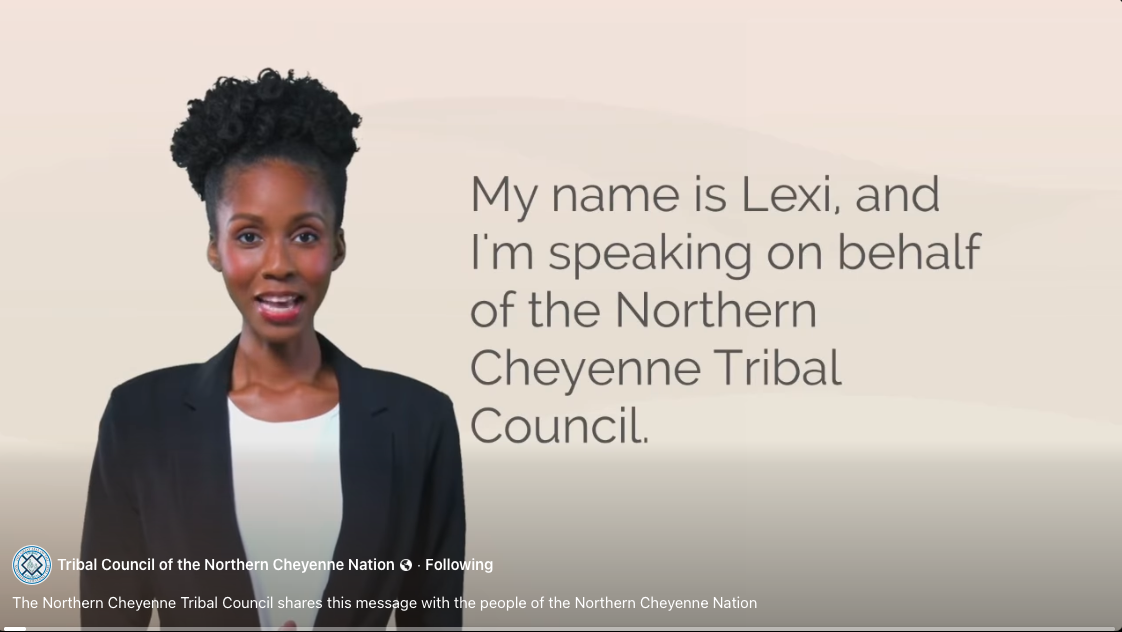
In a four-minute video shared by the council’s Facebook page on Dec. 8, Lexi, a Black AI avatar wearing a black blazer and white shirt, tells viewers that she is speaking on behalf of the Northern Cheyenne Tribal Council. The message, she said, is intended to explain what is happening with the tribal government.
|
 |
|
|
|
“This is not about personalities,” she says. “It’s not about pride. And it’s not about one side ‘winning.’ This is about protecting our Constitution and the democratic government that our people chose.”
Lexi goes on to recount various events of the conflict, claiming that the actions by the chiefs and president were “unlawful” and that the original council is the “legitimate council.” She also outlines several demands of the BIA, urging the federal agency to announce which body it recognizes, among other things.
Council member Melissa Lonebear told Montana Free Press that the group decided to use AI because “we’re trying to catch people’s attention.” A neutral messenger like an AI avatar, she said, was especially appealing to the group, who say they’ve been subject to threats of violence and online harassment.
In another short video shared by the council on Dec. 9, a cartoon drawing of a woman speaks in a robotic voice about the chiefs’ role in the conflict.
As the character speaks, corresponding images, like a microphone, a crown and a question mark, appear in her dialogue bubble. Sometimes, though, seemingly random images appear — a pair of shoes, a lock, and a dumbbell, among other things.
“We’ve gotten recommendations to use AI and to use TikTok,” Lonebear said. “And unfortunately, none of us are real masters at it. It’s new for us, but [the videos] provide a tutorial for people. It breaks things down.” |
|
|
|
|
|
|
After a multi-month lull, measles cases in Montana resurfaced again in late November and early December. According to the most recent update from the state health department, two measles cases have been identified in Broadwater County, with another one appearing in Gallatin County.
Broadwater County public health officials say that the two cases in their county are no longer contagious and that residents are only at risk of exposure if they have recently traveled to other communities where the highly transmissible disease may be circulating.
The Gallatin City-County Health Department has published a list of locations where people may have been exposed to measles in recent weeks. Officials there advise members of the public who may have been exposed to monitor for symptoms from Dec. 16 to Dec. 27, depending on the date of exposure.
Measles was first reported in Montana in April, as cases cropped up in hotspots across the country. Before that, the disease had been absent in Montana for more than 30 years. Since it resurfaced, Gallatin County has had the most cases by far, with 20.
Health officials have advised residents that the most robust, long-lasting defense against measles is medical immunization with the measles-mumps-rubella (MMR) vaccine. Children typically become eligible for the first dose of the MMR vaccine at 12 months of age, with the second dose typically administered after a child turns 4 years old. However, in periods of high exposure, health officials can approve an accelerated vaccination schedule to allow for infants as young as 6 months to receive an early MMR dose. Gallatin County currently has an accelerated vaccination schedule in place.
If contracted, measles can cause serious health issues in children and adults, including pneumonia and brain swelling. In extreme cases, measles can be deadly.
No measles-related deaths have been reported in Montana in 2025, though three people have died of the virus nationally, according to the federal Centers for Disease Control and Prevention. |
|
|
|
|
|
|
Viewshed 🌄
|
 |
|
|
|
This week, I was hoping to make a nice image of something holiday-y, like trees covered in luscious snow. Admittedly, selfishly, I wanted that as a skier as well. The weather, though, at least until Friday morning, had other intentions. Also this week, I went through all my photos from this year for a forthcoming retrospective. So, as I sit looking out at the gray, drab day, I figured why not share an image from late August of the Schillhammer family skipping rocks and swimming in the Clark Fork? The last breath of summer and pre-school freedom while I patiently wait for my last breath of rain this fall.
|
|
|
|
|
Lauren Miller
Report for America/Catchlight Local Photojournalist |
|
|
|
|
|
|
|
Highlights ☀️
|
|
In other news this week —
|
|
|
|
|
On Our Radar 
|
|
|
Nick — I’ve had an unhealthy, if seemingly irrational, fear of quicksand since watching Gilligan’s Island as a kid. Seems I was right, as this Utah hiker can attest.
Zeke — The season of Spotify Wrapped and Apple Replay, the year-end summaries of music streaming habits shared with each user in early December, is one of the best times to ponder the habits that define us and the apps that track them.
Jacob — If you’re willing to get away from the lights of town and brave the cold, this Saturday brings the peak of the Geminid meteor shower. It is one of the few astronomical events that really shines without a telescope. NASA estimates that, at the peak, there could be upwards of 120 meteors per hour if the skies are dark enough. This map is great for finding a spot with dark enough skies.
Mara — I ran a series of at-home experiments over the last couple of days to see what combination of over-the-counter medicines, nasal spray, hot toddies or spicy food could help rid me of a demonic cold. A neighbor dropped some Alka Seltzer in my mailbox, which may (?) have at least contributed to a better night’s sleep. Turns out, I probably should have turned to Google much earlier in the hopes of finding this helpful article.
Lauren — For reasons relating to a future story, I’m currently part of the Deer Lodge Community Group Facebook page, which was no easy feat. Being based in Helena, I had to apply twice! Two weeks ago, there was a kerfuffle regarding a missing cat named Moose, who I initially thought was a real moose, and that had apparently been catnapped! But here’s the twist: According to the post, the cat’s rightful owner knew the napper and was threatening to call the police if the cat wasn’t returned — and soon! Unfortunately, the original post has been removed, so while we may never get closure on Moose the cat, I can only hope that they were returned safely home, no worse for the wear and with an epic story.
*Some stories may require a subscription. Subscribe!
This week’s edition of the Lowdown was edited by Nick Ehli, with additional copy-editing by Holly Michels. |
|
|
|
|
|
|


